
Frozen tax thresholds might not necessarily sound like a tax rise. Yet, as your income increases while thresholds remain unchanged, a growing proportion of your wealth could gradually become liable to tax.
This effect – known as “fiscal drag” – is already bringing millions more into the scope of Income Tax, and pushing many taxpayers from the basic rate into higher tax bands.
Indeed, the Independent reports that 40.8 million people will pay Income Tax in 2026/27, a 1-million increase from the year before. Of those, 10.2 million will be over 65.
Moreover, Financial Planning Today forecasts that, by 2075/76, the number of higher-rate Income Tax payers could double to about two-thirds of all taxpayers.
While you can’t control tax thresholds, careful financial planning could help you manage the effect fiscal drag has on your finances.
Continue reading to discover why fiscal drag is having such an impact and three tax-efficient strategies that could help.
Frozen Income Tax thresholds mean more of your income could become taxable
Your Personal Allowance is usually the amount you can earn each year without paying Income Tax. In 2026/27, this stands at £12,570.
Above this amount, the Income Tax rates you pay depend partly on where in the UK you live, as shown in the table below.
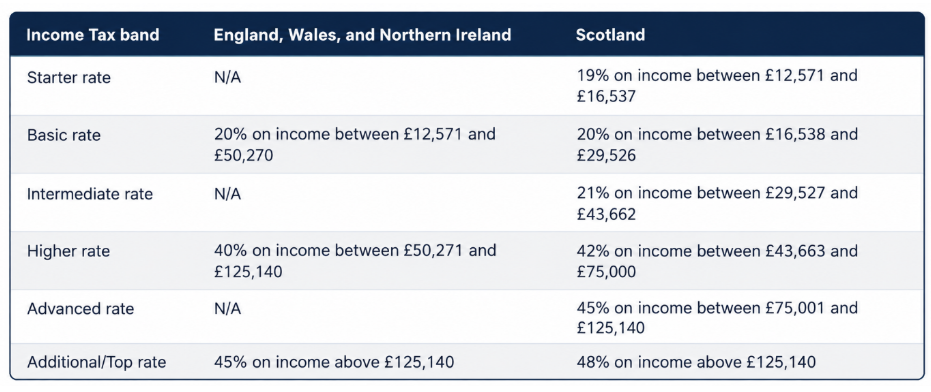
Importantly, many of these thresholds are not rising alongside wages, pensions, or inflation.
For instance, the UK government has extended the freeze on the Personal Allowance and higher-rate threshold applying in England, Wales, and Northern Ireland until April 2031.
As a result, if your salary or retirement income increases while the thresholds remain unchanged, a greater proportion of it could become liable for tax.
Thankfully, there are several ways you can improve the tax efficiency of your financial plan.
1. Review whether pension contributions could reduce your taxable income
Pensions can be one of the most effective ways to reduce your Income Tax liability while saving for the future.
This is because contributions typically benefit from tax relief, making them particularly valuable if fiscal drag has pushed you into a higher tax band.
For instance, if you pay Income Tax at 40% and your pension operates using “relief at source”, your provider will usually claim basic-rate relief of 20%.
You could then claim additional relief on contributions that align with any income taxed at the higher rate through self-assessment.
Pension contributions can also reduce your adjusted net income. This could be practical if your income exceeds £100,000.
Above this, your Personal Allowance tapers by £1 for every £2 of income until it’s completely lost at £125,140.
So, a substantial pension contribution could potentially help you retain some or all of your Personal Allowance.
Just note that the pension Annual Allowance stands at £60,000 in 2026/27, but yours may be lower if you’ve flexibly accessed a defined contribution pension.
2. Using your ISA allowance could prevent investment returns from adding to your tax bill
Any investments you hold outside a tax-efficient wrapper could also generate taxable dividends or gains. At the same time, interest from savings may become liable for Income Tax once you exceed your available allowances.
However, Individual Savings Accounts (ISAs) could help you limit this.
As of 2026/27, you can contribute up to £20,000 across your ISAs. Better yet, interest, investment returns, and capital gains generated within your ISAs are typically free from Income Tax, Capital Gains Tax, and Dividend Tax.
It’s worth noting that, from 6 April 2027, individuals aged under 65 will be subject to a £12,000 annual Cash ISA subscription limit, while those aged 65 and over will retain the ability to contribute up to £20,000 to Cash ISAs. The overall ISA allowance will remain at £20,000.
While contributing to an ISA won’t necessarily reduce the Income Tax due on your salary or pension, it could stop future investment returns or savings interest from increasing your tax liability.
Over the course of several years, regularly using your ISA allowance could allow you to build a significant pot of wealth from which you can make tax-efficient withdrawals later in life.
3. Carefully planning pension withdrawals could help you avoid crossing a tax threshold
If you’ve already retired, the way you access your wealth can be just as important as the amount you withdraw.
Your State Pension counts towards your taxable income, as does most taken from workplace and private pensions.
If you receive the full new State Pension in 2026/27, you will already earn £12,547.60 a year, leaving very little of your Personal Allowance available.
As such, withdrawing a large sum from a private pension could push more of your income into a higher tax band.
You can usually take the first 25% of your pension as a tax-free lump sum, subject to the standard Lump Sum Allowance of £268,275 (2026/27). The rest is normally subject to Income Tax when you withdraw it.
Rather than automatically drawing all of your retirement income from your pension, it might be prudent to combine various sources of wealth.
For instance, using ISA withdrawals alongside your pension income could potentially help you meet your spending needs without unnecessarily increasing your taxable income.
Similarly, spreading larger pension withdrawals across several tax years could help you make more effective use of your available tax bands.
Remember: this requires careful planning, as withdrawing too much from a pension too soon could leave you with a shortfall later in life.
We could help you reduce the effects of fiscal drag on your financial plan
With Income Tax thresholds frozen for several more years, fiscal drag could gradually increase the amount of tax you pay, even if rates themselves remain unchanged.
We could assess your income and assets alongside your financial goals, helping you identify opportunities to make better use of pensions, ISAs, and other available tax allowances.
This could help you build a more tax-efficient plan while ensuring any decisions continue to support your progress towards your long-term goals.
To learn more about how we can support you, please use our search function to find your nearest Verso office. Or, for Verso Investment Management enquiries, please contact us at info@versoim.com or call 020 7380 3300.
Please note
This article is for general information only and does not constitute advice. The information is aimed at retail clients only.
All information is correct at the time of writing and is subject to change in the future.
Please do not act based on anything you might read in this article. All contents are based on our understanding of HMRC legislation, which is subject to change.
The Financial Conduct Authority does not regulate tax planning.
A pension is a long-term investment not normally accessible until 55 (57 from April 2028). The fund value may fluctuate and can go down, which would affect the level of pension benefits available. Past performance is not a reliable indicator of future performance.
The tax implications of pension withdrawals will be based on your individual circumstances. Thresholds, percentage rates, and tax legislation may change in subsequent Finance Acts.
The value of your investments (and any income from them) can go down as well as up and you may not get back the full amount you invested. Past performance is not a reliable indicator of future performance.
Investments should be considered over the longer term and should fit in with your overall attitude to risk and financial circumstances.